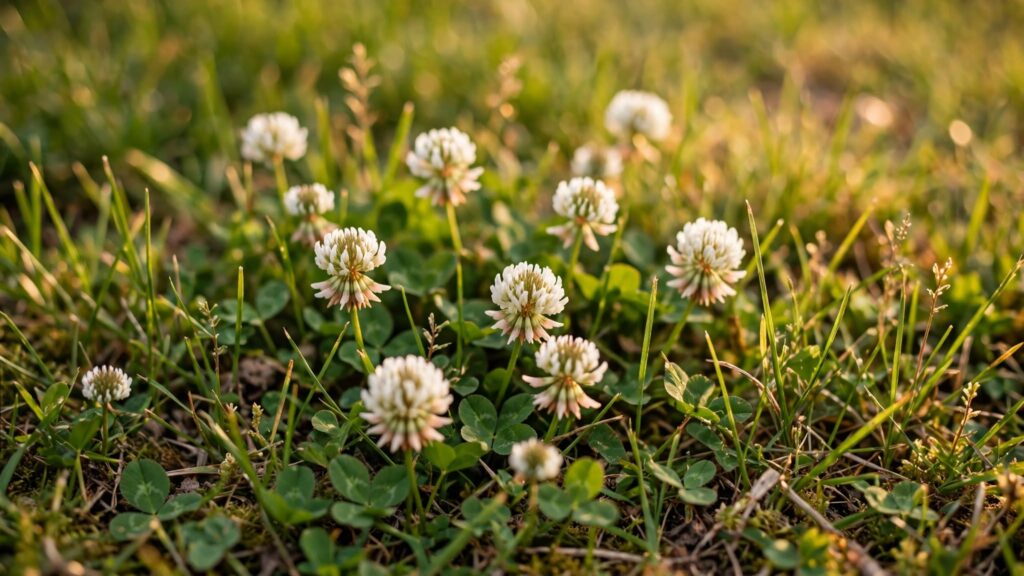
Clover spreading through turf tells you something specific about your soil. Learning how to get rid of clover in your lawn starts with understanding why it is winning. Clover fixes its own nitrogen from the air, so it thrives exactly where grass is starving. Therefore pulling it without changing the conditions simply invites it back. This guide covers removal and, more importantly, prevention.
Why Clover Takes Over
White clover is a legume. It hosts bacteria in its roots that convert atmospheric nitrogen into a usable form.
Grass cannot do that, so grass depends entirely on nitrogen in the soil. When soil nitrogen runs low, grass thins out and clover fills the gaps effortlessly. In short, clover is a symptom of low fertility rather than an aggressive invader.
Other conditions help it along too:
- Compacted soil, which clover tolerates better than grass
- Mowing too short, which weakens grass but not clover
- Soil pH outside the 6.0 to 7.0 range grass prefers
- Thin turf with bare patches
- Drought, since clover roots go deeper
Step 1: Test Your Soil
Start with a soil test rather than guessing. Kits are cheap, and most local cooperative extension offices test samples for a small fee.
You are looking at nitrogen levels and pH. The University of Minnesota Extension provides detailed guidance on interpreting results and matching fertiliser to what your soil actually needs.
Step 2: Feed the Grass
This is the single most effective long-term action. Apply a nitrogen-rich fertiliser so grass can outcompete clover.
Timing matters by grass type. Cool season grasses respond best in early autumn, while warm season grasses prefer late spring. Our guide on when to fertilize your lawn sets out a schedule for each type.
Avoid over-applying. Excess nitrogen burns grass and runs off into waterways.
Step 3: Pull It Out by Hand
For small patches, hand removal works well. Water the area first so the soil releases the roots.
Then loosen the soil with a hand fork and lift the clump, following the runners outward. Clover spreads by creeping stems called stolons, so any fragment left behind re-roots. Be thorough around the edges of each patch.
Afterwards, fill the bare spot with topsoil and grass seed immediately. Our guide on how to fix bare spots in a lawn covers that process.
Step 4: Smother Larger Patches
For a dense patch, cut off its light. Cover the area with black plastic or cardboard and secure the edges.
Leave it for three to four weeks. The clover dies back completely, though so does the grass underneath. Consequently, this method suits areas you plan to reseed anyway.
Step 5: Try Vinegar on Isolated Clumps
A spray of horticultural vinegar kills clover foliage on contact. Mix it with a drop of dish soap so it clings to the leaves.
Be careful, because it kills grass just as readily. Apply it with a small brush or a shielded sprayer, on a dry windless day. Expect to repeat the treatment, since the roots often survive the first application.
Step 6: Use a Selective Herbicide if Needed
For widespread clover, a broadleaf herbicide containing a product labelled for clover will work without harming turfgrass.
Apply in autumn when clover is actively storing energy in its roots, because the product travels down with it. Follow the label precisely, keep children and pets off the treated area for the stated period, and never apply before rain. Spot treat rather than blanket spraying wherever possible.
Step 7: Fix the Underlying Conditions
Removal without this step is temporary. Work through the following:
- Mow higher. Set the deck to 3 or 3.5 inches. Taller grass shades out clover seedlings and develops deeper roots.
- Aerate compacted soil. Our guide on how to aerate a lawn explains when and how.
- Adjust pH. Add lime if the soil is acidic, following your soil test recommendation.
- Water deeply but infrequently. One inch per week encourages deeper grass roots.
- Overseed thin areas. Our guide on when to plant grass seed covers the right window.
Mistakes to Avoid
- Do not pull clover and leave bare soil, because weeds colonise it within days.
- Do not mow short in an attempt to cut clover back. That favours clover over grass.
- Do not use a weed and feed product as a shortcut, since blanket herbicide application is rarely necessary.
- Do not apply herbicide in hot weather above 85 degrees, as it stresses the grass.
- Do not skip the soil test, because fertilising blindly wastes money.
Should You Keep It Instead?
Worth considering honestly. Clover stays green in drought, needs no fertiliser, tolerates foot traffic and supports pollinators.
Some homeowners deliberately overseed clover into their lawns for exactly those reasons. If your objection is purely appearance, a mixed clover and grass lawn is a legitimate and lower maintenance choice. If you want uniform turf, follow the steps above.
Final Thoughts
Now you know how to get rid of clover in your lawn properly. Test the soil, feed the grass with nitrogen, mow higher and remove what remains by hand or with a targeted herbicide. Fix the fertility problem and clover loses its advantage naturally. Our guide on how to kill weeds naturally covers the same approach for other lawn invaders.
Questions About How to Get Rid of Clover in Your Lawn
Why does clover keep coming back?
Because it fixes its own nitrogen and thrives where grass is underfed. Feeding the grass is the real fix.
Does vinegar work?
On foliage, yes, but it kills grass just as readily and the roots often survive.
Is mowing short a good idea?
No, the opposite. To get rid of clover in your lawn, mow at 3 to 3.5 inches so the grass shades out new seedlings.
Is clover worth keeping?
Some homeowners deliberately leave it, since it needs no fertiliser and feeds pollinators. You only need to get rid of clover in your lawn if you want uniform turf.
When should I apply herbicide?
In autumn, while the plant is moving energy into its roots. That timing makes it far easier to get rid of clover in your lawn for good.