Moss does not push grass out. It moves into ground where grass has already given up. Learning how to get rid of moss in your lawn therefore means fixing the conditions that weakened the turf in the first place. Raking moss out feels productive, but it returns within a season unless something changes. This guide covers both the removal and the underlying causes.
Why Moss Appears
Moss has no real roots and takes moisture directly through its leaves. As a result, it thrives where grass struggles. Look for these conditions:
- Shade. The most common cause. Most turfgrasses need four or more hours of direct sun.
- Compacted soil. Grass roots cannot penetrate, but moss does not need to.
- Poor drainage. Constantly damp ground suits moss perfectly.
- Acidic soil. Grass prefers pH 6.0 to 7.0, while moss tolerates much lower.
- Low fertility. Thin, hungry grass leaves gaps.
- Mowing too short. Scalped turf cannot compete.
Usually several of these combine. A shaded, compacted strip under a tree is the classic moss habitat.
Step 1: Test the Soil
Get a soil test before you treat anything. You need to know the pH and the nutrient levels.
Your local cooperative extension office will test a sample inexpensively. The Penn State Extension publishes clear guidance on moss in lawns and notes that moss itself is not the problem to attack.
Step 2: Rake the Moss Out
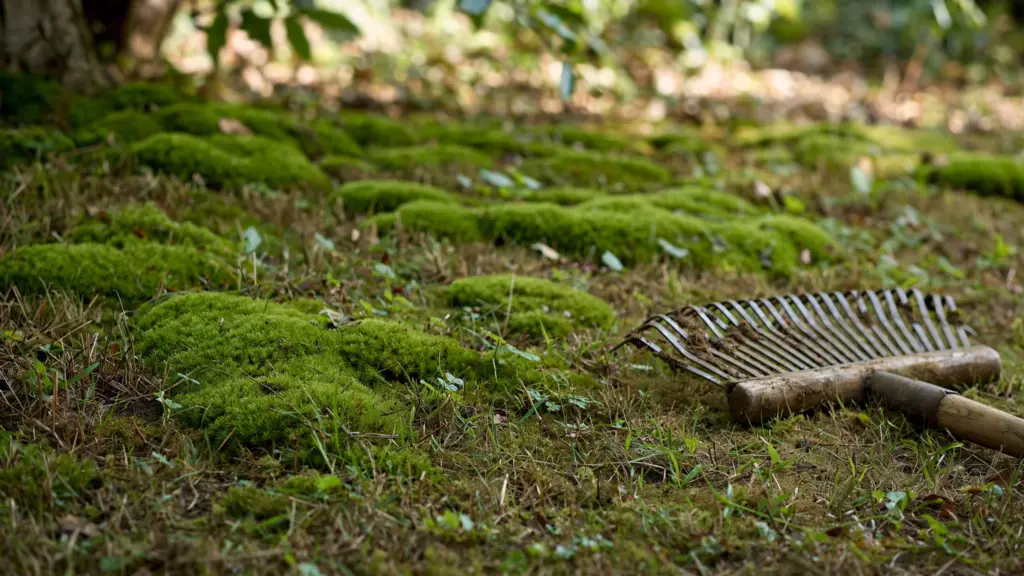
Because moss has no deep roots, it lifts out readily. Use a stiff spring-tine rake or a dethatching rake.
Work in two directions across each patch, scraping firmly down to the soil. For larger lawns, a powered dethatcher saves considerable effort. Then bag the debris rather than composting it, since moss fragments regrow easily.
Be prepared for how much bare ground this exposes. That is expected, and reseeding it is part of the job.
Step 3: Treat Stubborn Moss First if Needed
For thick mats, applying a moss killer before raking makes removal much easier. Products based on iron sulphate turn moss black within days.
Note that iron stains concrete, paving and clothing permanently. Keep it off hard surfaces and rinse any overspray immediately. Wait until the moss has blackened fully, then rake.
Step 4: Correct the Soil pH
If your test shows acidic soil below pH 6.0, apply lime at the rate your test recommends.
Do not guess the quantity. Over-liming causes nutrient lock-up that creates new problems. Lime also acts slowly, so expect several months before the pH shifts measurably. Autumn application works well.
Step 5: Relieve Compaction
Core aeration pulls plugs of soil out and lets air, water and roots move freely. This is one of the most valuable things you can do for a mossy lawn.
Our guide on how to aerate a lawn explains the timing and the method. Core aeration beats spike aeration, because spikes push soil sideways and can worsen compaction.
Step 6: Improve the Drainage
Standing water keeps the surface permanently damp. Address it directly.
Topdress low-lying areas with a sandy soil mix to level them. For persistent wet patches, consider a French drain or a dry well. Also check that downspouts discharge well away from the lawn. Our guide on how to clean gutters covers keeping roof water under control.
Step 7: Reduce the Shade
Shade is the hardest factor to change, but there are options.
Prune the lower limbs of trees and thin the canopy so dappled light reaches the ground. In addition, trim back overgrown shrubs along fences.
If an area genuinely cannot get four hours of sun, accept it and change your plan. Plant a shade-tolerant ground cover, lay mulch, or use a fine fescue blend which handles shade better than other turfgrasses.
Step 8: Reseed and Feed
Bare soil must be filled quickly or moss simply returns.
Spread a quality seed mix suited to your light conditions, then rake it lightly into the surface. Keep it consistently moist until germination. Our guides on when to plant grass seed and how to fix bare spots in a lawn cover the technique in detail.
Then fertilise on a proper schedule, following our guide on when to fertilize your lawn.
Step 9: Mow Higher
Raise the mower deck to 3 or 3.5 inches. Taller grass shades the soil surface, which discourages moss spores from establishing. It also encourages deeper roots that cope better with shade and drought.
Mistakes to Avoid
- Do not rake moss out and leave bare soil unseeded.
- Do not apply lime without a soil test.
- Do not let iron-based moss killer touch concrete or paving.
- Do not water lightly and often, because that keeps the surface damp.
- Do not mow short in deep shade.
- Do not fight moss indefinitely in an area that will never get enough sun.
Final Thoughts
Now you know how to get rid of moss in your lawn and keep it out. Rake it away, then correct the real causes: compaction, acidity, poor drainage and shade. Reseed the bare ground straight away and mow higher afterwards. Change the conditions and grass wins the space back on its own.
Questions About How to Get Rid of Moss in Your Lawn
Will lime kill the moss?
Not directly. Lime corrects acidic soil so grass competes better, and you should only apply it after a soil test.
Why does it return every spring?
Because the shade, compaction or drainage problem is still there.
What if the area never gets sun?
Stop fighting it. Rather than get rid of moss in your lawn permanently, plant a shade-tolerant ground cover or use mulch instead.
Should I rake before or after treating?
Treat thick mats first, then rake once blackened. That order makes it much quicker to get rid of moss in your lawn.
Does mowing height matter?
Yes. Mow at 3 inches or higher, because scalped turf lets moss straight back in.