A cabinet door that will not close sits slightly open, rubs its neighbour or swings back at you. Most people assume the hinge is broken. In reality, modern cabinet hinges are adjustable in three directions, and the fix is usually a quarter turn of one screw. This guide explains how to correct a cabinet door that will not close, whichever type of hinge you have.
First Identify Your Hinge Type
Open the door and look at the hardware.
- European or concealed hinges. A metal arm with a cup set into the back of the door. These are fully adjustable and standard in most kitchens built since the 1990s.
- Face frame hinges. Partly visible on the front of the cabinet, with limited adjustment.
- Old-style butt hinges. Fully visible leaves. Adjustment means shimming or repositioning.
The rest of this guide focuses mainly on concealed hinges, since they are the most common and the most adjustable.
Understand the Three Adjustment Screws
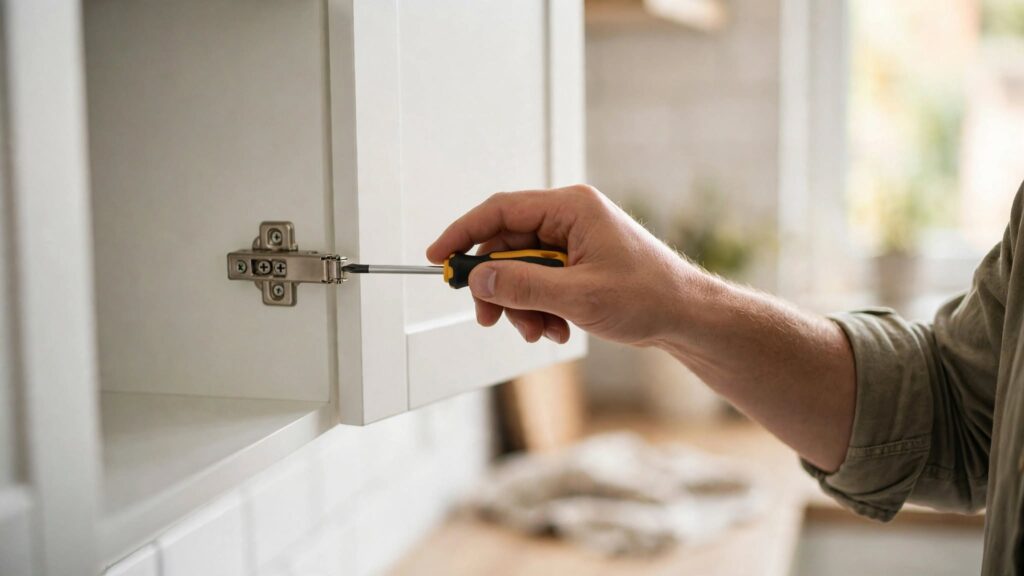
This is the key knowledge, and it saves a lot of trial and error. A concealed hinge has up to three screws, each controlling a different axis.
- Depth screw. Usually at the rear of the hinge arm. It moves the door closer to or further from the cabinet frame. Use this when the door will not sit flush.
- Side screw. Usually in the middle. It moves the door left and right. Use this to even up the gap between two doors.
- Height screws. The two screws fixing the mounting plate to the cabinet wall. Loosening them lets the whole door slide up or down.
Step 1: Diagnose the Symptom
Close the door gently and look at the gaps all round. Then match what you see to the cause.
- Door stands proud and will not sit flush. Turn the depth screw clockwise.
- Door rubs the one next to it. Adjust the side screw on both doors.
- Door sits crooked, with a wedge-shaped gap. Adjust the side screw on one hinge only.
- Door sags lower than its neighbour. Loosen the mounting plate screws and lift it.
- Door closes then springs open. Something is blocking it, or the hinge has lost its spring.
Step 2: Make Small Adjustments
Turn each screw no more than a quarter turn at a time. Then close the door and check. Small moves make a visible difference, and large moves overshoot badly.
Adjust the top hinge first, because it affects alignment most. Work on one screw and one hinge at a time so you can tell what changed.
Step 3: Tighten Loose Mounting Screws
If the door moves when you wiggle it, the hinge screws have worked loose. Tighten everything firmly but without forcing.
When a screw spins without grabbing, the hole in the particleboard has stripped. Fill it with wooden toothpicks dipped in wood glue, let it cure, then trim flush and redrive the screw. Alternatively, use a slightly thicker screw.
Step 4: Check What Is Blocking It
Sometimes nothing is wrong with the hinge at all. Look for these obstructions:
- Items inside the cabinet pressing against the door
- A shelf that has shifted forward
- A worn or missing bumper pad leaving the door to hit wood on wood
- Paint buildup on the cabinet frame edge
- A drawer or appliance handle fouling the swing
Step 5: Replace a Failed Hinge
Concealed hinges contain a spring or a soft-close damper. Both wear out. If a door will not stay shut no matter how you adjust it, the hinge has lost its closing tension.
Take one old hinge to the store to match the cup diameter, overlay type and mounting plate. Replace them in pairs so the door closes evenly. Soft-close replacements usually fit the same holes, which is a worthwhile upgrade.
Fixing Face Frame and Butt Hinges
These have little or no built-in adjustment. Instead, use cardboard shims behind one hinge leaf to shift the door, exactly as you would with an interior door. Our guide on how to fix a sticking door explains the shimming technique in more detail.
If the screw holes are worn, reposition the hinge slightly and fill the old holes with wood filler. Our guide on how to patch a hole in drywall covers the same filling principle for wall repairs.
Mistakes to Avoid
- Do not turn screws more than a quarter turn at a time.
- Do not adjust two hinges at once, because you lose track of what helped.
- Do not over-tighten screws in particleboard, since the threads strip easily.
- Do not force a door shut against an obstruction.
- Do not mix hinge brands on the same door.
Keep Cabinet Doors Aligned
Check and tighten cabinet hinges once a year. In addition, fit self-adhesive bumper pads to cushion closing and reduce vibration. Avoid hanging heavy items such as towels on cabinet doors, because the extra load pulls hinges out of alignment over time.
Kitchen cabinets near the sink also suffer from moisture, which swells particleboard and loosens screws. Our guide on how to find a water leak helps you catch a slow leak under the sink before it damages the cabinet box. For general upkeep timing, the Consumer Product Safety Commission also recommends checking that cabinet latches and safety catches work properly in homes with small children.
Final Thoughts
A cabinet door that will not close is nearly always an adjustment issue rather than a broken part. Learn what each of the three screws does, then make quarter turn changes and check as you go. Ten minutes of patient adjustment brings a whole row of doors back into line.
Questions About a Cabinet Door That Will Not Close
Which screw should I turn first?
The depth screw at the rear of the hinge arm, since that controls how flush the door sits.
Why does adjusting make it worse?
Usually because two hinges were changed at once. Adjust one screw on one hinge, then test.
When is the hinge itself at fault?
If a cabinet door that will not close springs open no matter how you adjust it, the hinge spring has failed and needs replacing in pairs.