A dull mower blade tears grass instead of cutting it. Those ragged ends turn brown within a day and leave the plant open to disease. Learning how to sharpen lawn mower blades takes about 30 minutes and visibly improves your lawn. This guide covers safe removal, two sharpening methods, balancing and how to tell when a blade is beyond saving.
Why Sharp Blades Matter
A sharp blade slices cleanly through the leaf. The grass seals that cut quickly and keeps growing.
A dull blade instead bruises and shreds the tip. Consequently, the lawn takes on a whitish or brown cast a day after mowing, loses more moisture through the damaged tissue, and becomes more vulnerable to fungal problems. In addition, a dull blade forces the engine to work harder and burns more fuel.
Signs Your Blade Needs Sharpening
- Grass tips look frayed, torn or white rather than cleanly cut
- The lawn turns brownish a day or two after mowing
- You notice uncut streaks of grass
- The mower bogs down in normal conditions
- You can see nicks or a rounded edge on the blade
What You Need
- Heavy work gloves and safety glasses
- A socket wrench and a block of wood
- A metal file, or an angle grinder with a metal disc
- A bench vice
- A wire brush
- A blade balancer, or a nail in a wall
- Penetrating oil
- A permanent marker
Step 1: Make the Mower Safe
This step is not optional, and skipping it causes serious injuries.
For a petrol mower, disconnect the spark plug wire. Then drain the fuel tank, or at minimum make sure it cannot spill when you tip the machine. For a battery mower, remove the battery entirely. For a corded electric, unplug it.
Tip the mower so the carburettor and air filter face upward. Tipping the other way floods the filter with oil and fuel.
Step 2: Remove the Blade
Mark the underside of the blade with the marker before you touch anything. Blades only cut in one direction, and refitting one upside down is a genuinely common mistake.
Wedge a block of wood between the blade and the deck to stop it rotating. Then loosen the centre bolt counter-clockwise. If it is seized, apply penetrating oil and wait fifteen minutes.
Note the order of any washers as they come off.
Step 3: Clean the Blade
Scrape off the caked grass and soil with a wire brush. You cannot see the cutting edge properly until it is clean, and debris clogs files and grinding discs.
Step 4: Sharpen It
Method A: Hand File
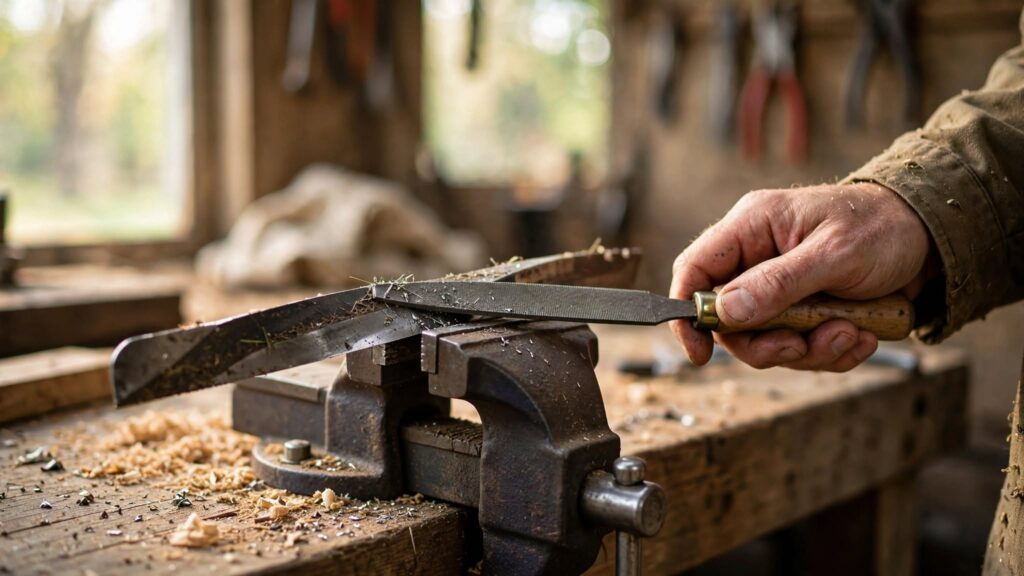
This is slower but very hard to get wrong. Clamp the blade in a vice with the cutting edge exposed.
Then push the file along the edge, following the existing bevel angle, which is usually 30 to 45 degrees. File in one direction only, lifting on the return stroke. Keep count of your strokes and apply the same number to each end.
Stop when the edge is uniform. It should be about as sharp as a butter knife, not a razor. An over-sharpened thin edge chips immediately on the first stone it hits.
Method B: Angle Grinder
Much faster, but easier to ruin a blade with. Secure the blade in a vice and wear a face shield.
Make light passes along the bevel, moving steadily from the inner end to the tip. Importantly, do not let the metal get hot enough to turn blue. That means you have burned off the heat treatment and the edge will dull quickly. Pause frequently and let it cool.
Step 5: Balance the Blade
Do not skip this. An unbalanced blade vibrates, which damages the crankshaft bearings and the mower deck over time.
Hang the blade on a nail through its centre hole, or use a cone balancer. A balanced blade sits level. If one end drops, remove a little more metal from that end and test again.
Step 6: Reinstall
Fit the blade with your marked side facing down toward the grass, so the cutting edges lead in the direction of rotation. The sail or raised wing on each end should point up into the deck.
Then tighten the centre bolt firmly, using a torque wrench to the manufacturer’s specification if you have one. Reconnect the spark plug or battery last, after everything else is complete.
When to Replace Instead of Sharpen
Replace the blade if you find any of the following:
- Cracks anywhere in the metal
- Deep gouges that would need major grinding to remove
- A noticeably thinned or worn trailing edge
- Bending or twisting
- A worn or enlarged centre hole
- Significant rust pitting
Blades are inexpensive, and a cracked one can shatter at full speed. The Consumer Product Safety Commission publishes mower safety guidance worth reading before any maintenance.
How Often to Sharpen
Sharpen after every 20 to 25 hours of mowing, which works out to roughly twice a season for most lawns. Sharpen more often on sandy soil, and inspect the blade any time you hit a rock or root.
Many people keep a spare blade so they can swap it in and sharpen at leisure. Doing this at the start and middle of the season fits naturally with other lawn work. Our guide on when to stop mowing in autumn covers end of season timing, and our guide on how to fix bare spots in a lawn explains why a sharp blade matters so much for new grass.
Mistakes to Avoid
- Do not forget to disconnect the spark plug or remove the battery.
- Do not tip the mower with the air filter facing down.
- Do not sharpen to a razor edge.
- Do not overheat the blade with a grinder.
- Do not reinstall a blade upside down.
- Do not skip balancing.
- Do not change the original bevel angle.
Final Thoughts
Now you know how to sharpen lawn mower blades properly. Disconnect the power, mark the blade before removal, file along the existing bevel, then balance it before refitting. Half an hour twice a season gives you a cleaner cut, a healthier lawn and a mower that lasts longer.
Questions About How to Sharpen Lawn Mower Blades
How sharp is sharp enough?
About as sharp as a butter knife. A razor edge chips on the first stone it hits.
Do I really need to balance it?
Yes. An unbalanced blade vibrates and damages the crankshaft bearings over time.
How often should this be done?
Every 20 to 25 hours of mowing. Most people sharpen lawn mower blades twice a season, or sooner after hitting a rock.
Which way does the blade go back on?
Cutting edges leading, sails pointing up into the deck. Mark the underside before removal so you can sharpen lawn mower blades without guessing.
Can I use an angle grinder?
Yes, with light passes. Never let the steel turn blue, because overheating ruins the temper when you sharpen lawn mower blades.