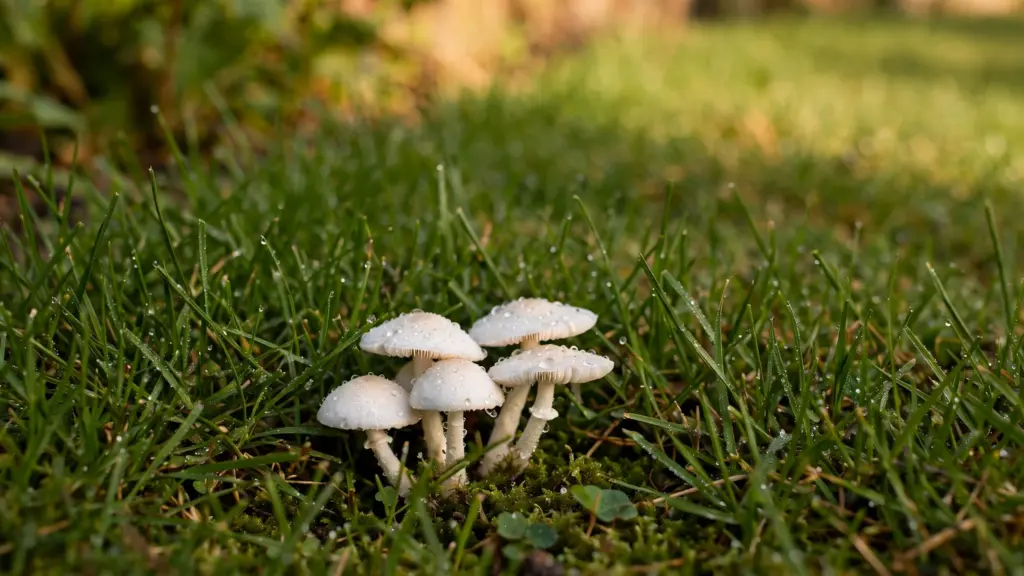
A crop of mushrooms in your lawn overnight looks alarming, yet it is rarely bad news. Mushrooms are the visible fruiting bodies of fungi that live in the soil and break down organic matter. In fact, their presence usually indicates biologically active, healthy soil. However, they can be a hazard around children and pets. This guide explains why mushrooms appear in lawns and how to deal with them sensibly.
What Mushrooms Actually Tell You
Beneath your grass runs a network of fungal threads called mycelium. It feeds on dead organic material, including buried roots, old tree stumps, construction debris and thatch.
When conditions turn right, that mycelium pushes up mushrooms to release spores. Consequently, mushrooms are not attacking your grass. They are a sign that decomposition is happening, which actually improves soil structure and releases nutrients.
Why They Appear When They Do
Four conditions usually trigger a flush:
- Prolonged moisture. Several days of rain or heavy irrigation.
- Mild temperatures. Spring and autumn are peak seasons.
- Buried organic matter. Old stumps, tree roots and construction scrap.
- Shade and poor air circulation. Damp conditions persist longer.
This explains why they often appear in the same spot each year. An old buried stump keeps feeding the fungus for a decade or more.
Are Lawn Mushrooms Dangerous?
To your grass, no. Most lawn mushrooms are harmless saprophytes.
To people and pets, treat every wild mushroom as potentially toxic. Identification requires expertise, and some dangerous species look very similar to edible ones. The National Capital Poison Center advises contacting a poison control centre or vet immediately if a child or pet eats an unidentified mushroom. Never eat mushrooms growing in a lawn.
Step 1: Remove Them Safely
If you have small children or dogs, removal is worthwhile.
- Wear gloves.
- Pick the mushrooms by hand, grasping at the base and twisting gently.
- Bag them and put them in the bin rather than the compost.
- Wash your hands afterwards.
- Check again each morning during a wet spell, since new ones appear quickly.
Avoid mowing over mushrooms, because that scatters spores across the lawn and spreads the next flush more widely.
Step 2: Reduce Surface Moisture
You cannot control rain, but you can control irrigation. Water deeply and infrequently instead of lightly every day.
Aim for one inch per week in one or two sessions. Water early in the morning so the surface dries during the day. That single change often reduces mushroom flushes noticeably.
Step 3: Dethatch and Aerate
Thatch is a layer of dead organic matter sitting at the soil surface, and it feeds fungi while holding moisture.
Rake out thatch thicker than half an inch. Then core aerate to improve drainage and air movement through the soil. Our guide on how to aerate a lawn covers the timing and method.
Step 4: Remove the Food Source if You Can
For mushrooms that return in the same spot every year, something is buried there.
Dig down and look for old tree roots, a stump or construction debris. Removing it is the only permanent solution for that patch. Grinding a stump removes the visible part but leaves the roots, which is why mushrooms often persist for years after a tree comes down.
Step 5: Improve Light and Airflow
Prune low tree limbs and thin dense canopies so sunlight reaches the ground. Also trim shrubs that block air movement across damp areas. Drier surfaces produce fewer mushrooms.
What About Fairy Rings?
A circle or arc of mushrooms, often with a ring of darker or deader grass, is a fairy ring. The fungus grows outward from a central point, which creates the shape.
Fairy rings are harder to manage, because the mycelium can make the soil water repellent. Aerate the ring thoroughly, then water deeply with a wetting agent to help moisture penetrate. In addition, apply nitrogen fertiliser to mask the colour difference. Complete eradication usually means removing and replacing the soil, which is rarely worth it.
Why Fungicides Are Not the Answer
Fungicides target the fruiting bodies, not the mycelium running through the soil. Therefore the mushrooms return as soon as conditions suit.
They are also expensive, kill beneficial soil fungi that help grass take up nutrients, and treat a cosmetic issue. Save them for actual turf diseases.
Mistakes to Avoid
- Do not eat any mushroom growing in a lawn.
- Do not mow over mushrooms, since it spreads spores.
- Do not apply fungicide for ordinary lawn mushrooms.
- Do not water lightly every day.
- Do not compost the mushrooms you remove.
- Do not panic. They usually disappear within days once the weather dries.
Keep the Lawn Strong
A dense, well-fed lawn makes mushrooms far less noticeable even when fungi are active below. Follow a proper feeding schedule using our guide on when to fertilize your lawn, fill thin areas using our guide on how to fix bare spots in a lawn, and address damp shady ground using our guide on how to get rid of moss in your lawn.
Final Thoughts
Mushrooms in your lawn are a sign of active soil biology rather than a problem to eradicate. Pick them off if children or pets use the garden, water less often and dethatch to dry the surface out. Beyond that, they fade on their own as soon as the weather turns dry.
Questions About Mushrooms in Lawn Areas
Are they killing my grass?
No. They feed on dead organic matter and actually indicate biologically active soil.
Should I use a fungicide?
No. It targets the visible caps, not the mycelium below, so they simply return.
Why do they appear in the same spot each year?
Something is buried there, usually an old stump or root. Mushrooms in lawn areas follow their food source.
Will they damage my grass roots?
No. Mushrooms in lawn turf feed on dead material, so the living grass is unaffected.