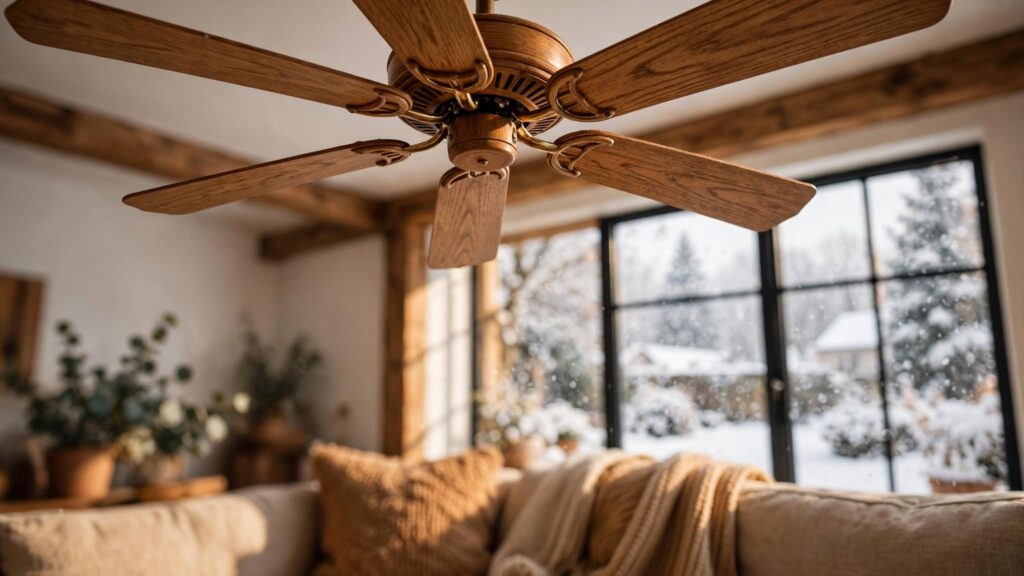
Most people never touch the little switch on the fan housing, which means they run the same direction all year. So which way should a ceiling fan turn in winter? The answer is clockwise, on the lowest speed. That setting pulls air upward and pushes the warm layer near the ceiling gently down the walls. This guide explains how to check and change the direction, and how much difference it genuinely makes.
The Short Answer
- Winter: clockwise, on low speed. This is sometimes labelled reverse or winter mode.
- Summer: counter-clockwise, on medium or high speed.
A simple memory trick helps. Clockwise for cold, counter-clockwise for comfort in the heat.
Why Clockwise Works in Winter
Warm air rises, so the air near your ceiling is several degrees warmer than the air at head height. In a room with high ceilings, that difference can be considerable.
Running the fan clockwise on low draws air up through the centre of the room. That air then spreads out across the ceiling and flows down along the walls. As a result, the warm layer mixes into the living space without creating a draft you can feel.
Speed matters here. On high speed, the fan creates enough air movement to produce a wind chill effect, which defeats the purpose entirely. Low is essential.
Why Counter-Clockwise Works in Summer
In summer you want the opposite. Counter-clockwise rotation pushes air straight down, creating a breeze across your skin.
That moving air speeds up evaporation and makes a room feel about 4 degrees cooler than it is. The U.S. Department of Energy notes that this effect lets you raise the thermostat by about 4 degrees with no loss of comfort. Our guide on the best AC temperature in summer covers how to use that.
How to Tell Which Way Your Fan Is Spinning
Stand directly underneath the fan and look up while it runs on medium.
If you feel air pushing down on your face, it is turning counter-clockwise, which is the summer setting. If you feel little or no downward breeze, it is turning clockwise in winter mode.
You can also watch the blade edges. The leading edge of each blade sits slightly higher than the trailing edge. In summer mode, that higher edge moves forward counter-clockwise when viewed from below.
How to Change the Direction
Fans With a Housing Switch
Most fans have a small slide switch on the motor housing, just above the blades.
- Turn the fan off and wait until the blades stop completely.
- Locate the switch on the side of the housing.
- Slide it to the opposite position.
- Turn the fan back on and set it to low.
- Stand underneath to confirm there is no strong downdraft.
Never flip the switch while the blades are moving, because it can damage the motor.
Fans With a Remote or Wall Control
Newer fans often have a reverse button on the remote, sometimes marked with a circular arrow. Some require holding the fan button for a few seconds. Check the manual if nothing is labelled.
Smart Fans
App-controlled fans usually have a direction setting in the device options. Many also allow seasonal schedules.
How Much Does It Actually Save?
Be realistic about expectations. In winter, the saving comes from being able to lower your thermostat by one or two degrees while feeling the same.
That translates to roughly 3 to 5 percent off heating costs for each degree. The benefit is largest in rooms with ceilings above nine feet, in rooms with vaulted ceilings, and in open-plan spaces where warm air collects high up. In a standard eight foot room, the difference is modest but still real.
Remember that a fan motor uses electricity too. On low speed that draw is small, typically under 20 watts, so the net saving remains positive.
Mistakes to Avoid
- Do not run the fan on high in winter, because you will feel a chill.
- Do not change direction while the blades spin.
- Do not leave fans running in empty rooms, since fans move air rather than changing temperature.
- Do not expect a fan to replace heating or cooling. It redistributes air only.
- Do not forget to switch back in spring.
While You Are Up There
Dust the blades before the heating season starts. A thick layer of dust unbalances the fan and spreads particles through the room each time it runs.
Also check that the mounting screws and canopy are tight, because wobble gets worse over time. If your fan wobbles badly or makes noise, our guide on how to install a ceiling fan covers mounting and balancing.
Combine It With Bigger Wins
Fan direction is a free adjustment, but it works best alongside the measures that actually reduce heat loss. Our guides on how to seal air leaks and how to insulate an attic address where most warmth escapes. Then set a sensible setpoint using our guide on the best thermostat temperature for winter, and work through our guide on how to winterize your home before the first freeze.
Final Thoughts
So, which way should a ceiling fan turn in winter? Clockwise, on the lowest speed, so warm air near the ceiling circulates down without creating a draft. Switch it back to counter-clockwise in spring. It takes ten seconds per fan, twice a year, and it costs nothing at all.
More on Which Way Should a Ceiling Fan Turn in Winter
How do I tell which way it is spinning?
Stand underneath. A noticeable downward breeze means counter-clockwise, which is the summer setting.
Does speed matter?
Very much. Which way should a ceiling fan turn in winter is only half the answer, because it must also run on low or you will feel a chill.
How much will it save?
Enough to lower the thermostat a degree or two, which is roughly 3 to 5 percent per degree.
Do I need to switch it back in spring?
Yes. The answer to which way should a ceiling fan turn in winter reverses in summer, so flip the switch counter-clockwise once the heating goes off.