Sooner or later the spot where you need a fixing has no framing behind it. Learning how to hang heavy things on drywall without a stud comes down to choosing the right anchor and matching it honestly to the load. Drywall is weak on its own, but the correct anchor spreads force across a much wider area. This guide explains each anchor type, its real weight limit and how to install it properly.
Why Drywall Alone Will Not Hold
Drywall is gypsum plaster sandwiched between paper. It is only half an inch thick in most homes. A plain screw driven into it grips almost nothing and pulls out under very little load.
Good anchors solve this by expanding or pivoting behind the panel. Consequently, the load bears against the back face of the drywall rather than the screw threads. That distinction is what makes heavy hanging possible.
Anchor Types and What They Hold
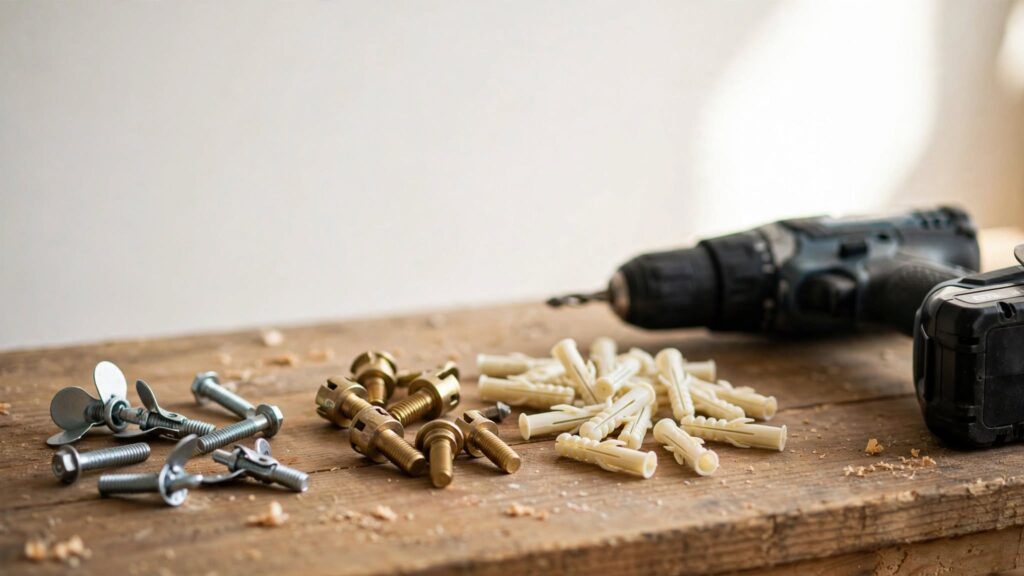
1. Plastic Expansion Anchors: Up to 10 Pounds
These are the ribbed plastic sleeves that come free with shelf kits. They are suitable for lightweight items only, such as small picture frames or a smoke alarm. Honestly, they are the weakest option available and not suitable for anything heavy.
2. Self-Drilling Threaded Anchors: 20 to 30 Pounds
These look like large plastic or metal screws with coarse threads. They drive straight into drywall with a screwdriver and need no pilot hole.
They work well for medium loads such as a towel rail or a small mirror. However, they fail if you overtighten them, because the threads chew through the gypsum.
3. Molly Bolts: 25 to 50 Pounds
A molly bolt has a metal sleeve that collapses and flares out behind the drywall as you tighten the screw. The flared legs grip a wide area.
Importantly, the sleeve stays in the wall when you remove the screw. Therefore you can unscrew and refit an item without losing the anchor, which is handy for things you take down occasionally.
4. Toggle Bolts: 50 to 100 Pounds
This is the strongest traditional option. A spring-loaded metal wing folds flat to pass through the hole, then springs open behind the panel.
Toggle bolts carry serious weight. The trade-off is that they need a larger hole, and the wing drops inside the wall cavity if the bolt is removed.
5. Strap Toggles and Snap Toggles: 60 to 120 Pounds
These modern anchors use a metal channel pulled flat against the back of the drywall by plastic straps. You then snap the straps off and drive a machine bolt in.
They are easier to install than classic toggles and leave a reusable thread. For genuinely heavy items on hollow walls, this is the best choice available.
How to Install a Toggle Bolt Step by Step
- Check for pipes and wiring first. Never drill blindly, especially above or below outlets and switches.
- Mark your position and drill the hole size stated on the packaging, which is usually half an inch.
- Pass the bolt through the item you are mounting before you fit the toggle.
- Thread the toggle wing onto the bolt so the wing tips point back toward the bolt head.
- Pinch the wing flat and push it through the hole until you hear it spring open.
- Pull back on the bolt to seat the wing against the inside of the drywall.
- Then tighten the bolt while maintaining that outward tension.
Spread the Load Across Several Anchors
This principle matters more than the anchor rating. Two anchors share a load, but they rarely double the capacity, because force is seldom evenly distributed.
Therefore, derate deliberately. Use anchors rated for at least twice the actual weight, and space them as far apart as the fixture allows. Wider spacing reduces leverage on each one.
Mistakes to Avoid
- Do not trust the maximum number on the packaging. Those figures come from ideal lab conditions.
- Do not use plastic expansion anchors for anything you would mind falling.
- Do not overtighten threaded anchors, since they strip the gypsum.
- Do not drill without checking for wires and pipes.
- Do not mount a TV, cabinet or anything above a bed or crib on drywall anchors alone. Those must hit studs.
- Do not ignore the shear versus pullout difference. Anchors handle downward shear far better than outward pull.
When You Really Need a Stud
Some loads should never rely on hollow wall anchors. Use a stud finder and hit framing for:
- Wall-mounted televisions
- Upper kitchen cabinets
- Grab bars and handrails
- Heavy bookshelves
- Anything a child could climb on
The Consumer Product Safety Commission runs a furniture tip-over prevention campaign, and its guidance is clear that heavy furniture should be anchored into structural framing. If no stud sits where you need one, add a horizontal wood cleat screwed into two studs, then mount to the cleat.
For items that do line up with framing, our guide on how to hang floating shelves covers that approach. When you remove an anchor later, our guide on how to patch a hole in drywall explains how to fill the hole neatly.
Final Thoughts
You can hang heavy things on drywall without a stud, provided you choose the right anchor and respect its limits. Snap toggles and toggle bolts handle real weight, while plastic sleeves do not. Always check for wiring first, use more anchors than you think you need, and hit framing for anything that could injure someone if it fell.
Questions About How to Hang Heavy Things on Drywall Without a Stud
Which anchor holds the most?
Snap toggles and strap toggles, at roughly 60 to 120 pounds each when installed correctly.
Can I mount a TV this way?
No. Televisions, cabinets and grab bars must be fixed into studs or a wood cleat spanning two studs.
Should I trust the packaging rating?
Derate it by half. When you hang heavy things on drywall without a stud, use anchors rated for at least twice the real load.
Do several anchors double the capacity?
Rarely, because load is seldom shared evenly. Spread them as widely as the fixture allows when you hang heavy things on drywall without a stud.