The outdoor half of your air conditioner has one job, which is dumping heat from your house into the outside air. Learning how to clean AC condenser coils keeps that process working efficiently. When the fins clog with dirt, the system runs longer, costs more and wears out sooner. This guide explains how to clean AC condenser coils safely in about an hour, once a year.
Why Dirty Coils Cost You Money
The condenser coil is the ring of thin aluminium fins wrapped around the outdoor unit. Refrigerant flows through tubing inside it, and air passing over the fins carries heat away.
Dirt forms an insulating blanket over those fins. As a result, the refrigerant stays hotter, the compressor works harder and the pressure rises. Studies by the U.S. Department of Energy show that a dirty condenser can cut efficiency substantially, and in severe cases it causes the compressor to fail entirely.
Signs Your Coils Need Cleaning
- The system runs almost continuously on warm days
- Air from the vents is cool but not cold
- The outdoor unit feels unusually hot to stand beside
- Electricity bills have climbed without a change in habits
- You can see visible debris or matted fins
- The unit cycles off on its high pressure switch
What You Need
- A screwdriver or socket set
- A soft brush or coil brush
- A garden hose with a standard spray nozzle
- No-rinse foaming coil cleaner
- A fin comb, optional but useful
- A shop vacuum with a brush attachment
- Work gloves and safety glasses
Step 1: Cut the Power, Twice
This is not negotiable. The outdoor unit contains a capacitor that holds a dangerous charge and a fan that can start without warning.
First, switch off the indoor breaker for the air conditioner. Second, pull the disconnect box mounted on the wall beside the outdoor unit. Having both off means nothing can energise while your hands are inside.
Step 2: Clear the Surrounding Area
Remove leaves, grass clippings, weeds and anything stacked against the unit. Then trim vegetation back so there is at least two feet of clearance on all sides and five feet above.
Airflow around the unit matters as much as the coil itself. Fences and shrubs that crowd the condenser cause the same problem as dirty fins.
Step 3: Remove the Top Grille and Vacuum Debris
Unscrew the fan grille from the top. Lift it carefully, because the fan motor is attached and its wires have limited slack. Rest it to one side without straining the wiring.
Then vacuum leaves and debris from the bottom of the cabinet. A surprising amount collects in there.
Step 4: Brush the Fins Gently
Brush the outside of the coil with a soft brush, working in the same direction as the fins run, which is vertically on most units.
Use light pressure. These fins are thin aluminium and bend if you push sideways. Brushing dislodges the loose surface layer so the cleaner can reach what is underneath.
Step 5: Apply Coil Cleaner
Spray a no-rinse foaming coil cleaner evenly across the fins from the outside. The foam expands and pushes dirt outward as it works.
Let it dwell for the time on the can, usually ten to fifteen minutes. Choose a product labelled for condenser coils, and avoid harsh acidic cleaners which corrode aluminium.
Step 6: Rinse From the Inside Out
This is the step that matters most, and most people get it backwards.
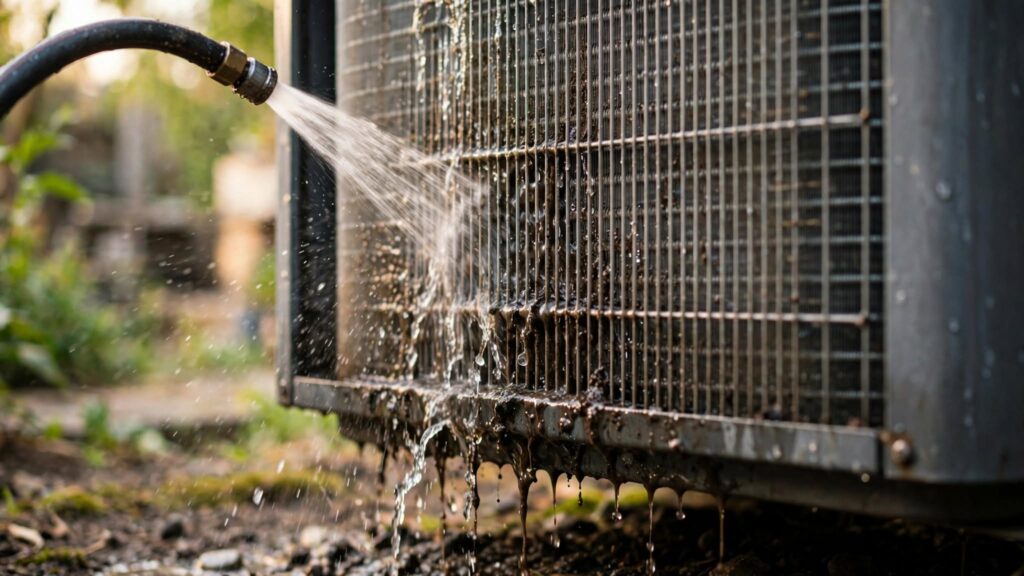
Reach the hose down inside the cabinet and spray outward through the coil. Dirt entered from the outside, so flushing it back the way it came pushes it out rather than packing it deeper.
Use a normal garden hose pressure. Never use a pressure washer, because it flattens the fins permanently and can damage the tubing. Work your way around all accessible sides.
Step 7: Straighten Bent Fins
Bent fins block airflow in exactly the same way dirt does. Run a fin comb gently through the affected area, matching the comb to the fin spacing.
Work slowly and do not try to perfect every fin. Correcting the worst patches gives most of the benefit.
Step 8: Reassemble and Test
Let the coil air dry for about twenty minutes. Then refit the grille and all screws.
Restore the disconnect first, then the indoor breaker. Run the system for fifteen minutes and check that air from the vents is genuinely cold. A healthy system drops the air temperature by 15 to 20 degrees between the return and the supply.
Mistakes to Avoid
- Do not use a pressure washer.
- Do not rinse from the outside inward, because it embeds the dirt.
- Do not work on the unit with power connected.
- Do not touch the capacitor or any wiring.
- Do not use acidic or caustic cleaners on aluminium fins.
- Do not let the fan grille hang by its wires.
- Do not cover the unit tightly in winter, as trapped moisture causes corrosion. A top-only cover is fine.
Do Not Forget the Indoor Coil
The evaporator coil indoors also collects dust, though it is harder to reach. Changing the filter regularly is the best protection, and our guide on how often to change your air filter explains the schedule. If your system still underperforms after cleaning both coils, our guide on why an AC runs but does not cool works through the remaining causes.
How Often to Clean the Coils
Once a year in spring suits most homes. Clean twice a year if you have cottonwood trees nearby, live on a gravel road, or keep the unit close to a clothes dryer vent.
Combining this with other seasonal work makes it easier to remember. Our home maintenance checklist lays out the full schedule, and our guide on how to lower your electric bill covers the broader savings picture.
Final Thoughts
Now you know how to clean AC condenser coils properly. Kill the power at two points, brush gently, apply a foaming cleaner, then rinse from the inside outward with ordinary hose pressure. One hour each spring keeps the system efficient and meaningfully extends the compressor’s life.
Questions About How to Clean AC Condenser Coils
Which direction should I rinse?
From the inside outward. Dirt entered from the outside, so flushing it back the way it came pushes it clear.
Can I use a pressure washer?
Never. It flattens the aluminium fins permanently and can damage the tubing.
How often is this needed?
Once a year is enough for most homes. Learning how to clean AC condenser coils is most valuable in spring, before the cooling season starts.
Do I need to remove the fan grille?
Yes, to vacuum debris from the cabinet floor. You cannot properly clean AC condenser coils without rinsing from the inside out.