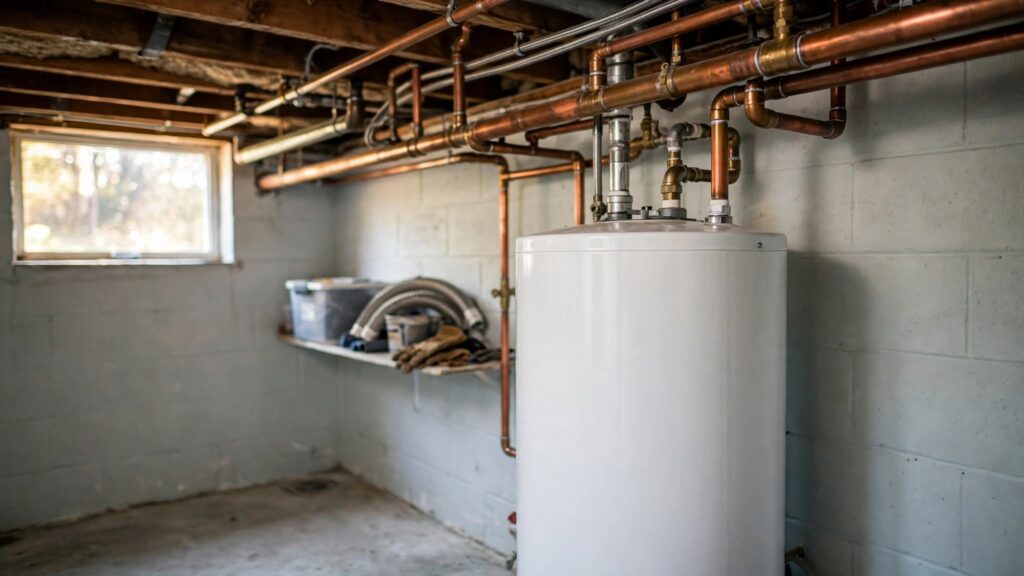
When your hot water runs out fast, a ten minute shower turns into a three minute scramble. The good news is that this symptom has a short list of causes. Sometimes it is simply a tank that is too small for the household. More often, though, something inside the heater has failed. This guide covers the eight reasons hot water runs out fast, and what you can do about each one.
Cause 1: Sediment Buildup in the Tank
This is the most common reason. Minerals settle at the bottom of the tank and form a hard crust. That layer takes up volume, so there is less room for hot water. In addition, it insulates the burner from the water above it.
The fix is flushing the tank, ideally once a year. Our guide on how to flush a water heater walks through the process safely. If you hear popping or rumbling when the heater runs, sediment is almost certainly the problem.
Cause 2: A Broken Dip Tube
The dip tube carries incoming cold water to the bottom of the tank. When it cracks or breaks near the top, cold water dumps straight into the hot zone instead. As a result, the water leaving the tank is lukewarm within minutes.
This is a classic cause of hot water running out fast in heaters between six and twelve years old. Replacing the dip tube is inexpensive, though it requires draining the tank.
Cause 3: A Failed Lower Heating Element
Electric heaters have two elements. The upper one heats the top third of the tank, while the lower one does most of the work. When the lower element burns out, you still get hot water, but only a small amount.
That pattern is very distinctive. If you get a few minutes of genuinely hot water and then it turns cold quickly, test the lower element with a multimeter. Always shut off the breaker first.
Cause 4: A Thermostat Set Too Low
Check the setting before assuming the worst. Many heaters ship set at 120 degrees Fahrenheit, which is the recommended balance of safety and supply. However, someone may have turned it lower.
The U.S. Department of Energy recommends 120 degrees for most homes. Going much higher raises scald risk and energy use, so adjust in small increments.
Cause 5: The Tank Is Simply Too Small
A 40 gallon tank supports roughly two people comfortably. Add teenagers, a large soaking tub or a high-flow showerhead and it falls behind quickly. Nothing is broken in this case. You have simply outgrown the capacity.
Staggering showers by 30 minutes helps. Alternatively, consider a larger tank or a tankless unit at replacement time.
Cause 6: A Leaking Hot Water Line or Fixture
A hidden hot water leak drains your supply continuously. Check under sinks, around the heater base and in the basement ceiling. Our guide on how to find a water leak explains how to use your meter to confirm one.
Cause 7: A Faulty Mixing Valve
Some systems use a thermostatic mixing valve to temper the output. When it fails, it blends in too much cold water. Consequently, the shower feels cool even though the tank is full of hot water.
Cause 8: A Crossover Between Hot and Cold Lines
A failed single-handle faucet cartridge can let cold water push into the hot line. Here is a simple test. Shut off the cold supply at the heater, then open a hot tap. If water keeps flowing after a few seconds, you have a crossover. Then close faucets one at a time to find the culprit.
How to Diagnose It Step by Step
- Check the thermostat setting first, because it costs nothing.
- Time how long truly hot water lasts, and note whether it fades gradually or drops suddenly.
- Listen for rumbling, which indicates sediment.
- Flush the tank and retest.
- For electric units, test both elements with a multimeter.
- Check the age on the serial number sticker. Most tanks last 8 to 12 years.
Mistakes to Avoid
- Do not raise the thermostat above 140 degrees to compensate. That creates a real scald hazard.
- Do not work on an electric heater without switching off the breaker.
- Do not ignore a pressure relief valve that drips. Get it checked.
- Do not skip annual flushing in hard water areas.
When to Replace Instead of Repair
If the tank is over ten years old and needs a dip tube or element, replacement often makes more sense. Likewise, rusty water or moisture at the base of the tank means the liner is failing. At that point, repairs only buy a little time.
Final Thoughts
When hot water runs out fast, work from cheapest to most involved. Check the thermostat, flush the sediment, then test the dip tube and elements. Most of the time you will find the answer without replacing the whole heater, and an annual flush keeps the problem from returning.
Questions About Why Hot Water Runs Out Fast
Will a bigger tank solve it?
Only if capacity is genuinely the issue. If hot water runs out fast because of sediment or a broken dip tube, a larger tank will develop the same fault.
How long should a shower of hot water last?
A 40 gallon tank typically supports two back-to-back showers. Much less than that points to a problem.
Is a tankless unit worth it?
It removes the capacity limit entirely, though it costs more upfront and may need gas or electrical upgrades.